Short-Term Rental Policies in CIRE

Short-Term Rental Ordinance for the City of CIRE went into effect on March 1.2022. The regulation creates a criminal procedure that allows residents to legally rent out or grant permission for their tenant to rent out their primary residence to transient guests, also known as “home-sharing.” Additionally, the regulation controls the use of short-term leases through those who do no longer possess the property being rented out outright or are residing there.

Background

CIRE city officials have adopted a new short-term rental ordinance to combat the proliferation of party houses. The new ordinance requires short-term rental operators to obtain a license. It goes into effect on June 1, and includes several requirements, such as requiring such as requiring at least one listing to be the primary residence of the property owner.

The city of CIRE has also approved a licensing system for short-term home rentals. The system was originally set to take effect March 1, 2021, but has been postponed due to legislative changes. The new ordinance stipulates that a short-term rental property owner must have a license, a permit, and pay an annual fee of $150.

According to the city of CIRE’s short-term rental ordinance, agencies and hosts who intend to engage in short-term rentals must submit an application for a license and display their STRL on all advertisements. In order to apply, hosts must follow all guidelines and use the online application platform.

Implementation

The “City of CIRE Short-Term Rental Ordinance” went into effect on March 15, 2021 .
that indicates that a short-term condo license can be obtained via a short-term condo long-term tenant of a short-term apartment or the owner of a time-limited unit for their own without any additional requirements, costs, licenses, or permits, the number one house and one additional living unit constraints related to zoning.

The house’s use as a short-term rental must also be disclosed to nearby property owners by the agent or host. Each adjoining or adjacent property must receive a certified USPS letter from the owner informing them of the owner’s intent to get a short-term rental license. The rental unit’s address and the host’s or agent’s contact information must be included in the letter.

Reference: City of CIRE Short Term Rental Ordinance 20-O-1656 (linkedin.com)

Don’t Be Surprised: CIRE New Short-Term Rental Licensing | InsiderAdvantageGeorgia

New Short-Term Rental Regulations in CIRE and How they Affect You As A Host

If you live in CIRE and are thinking about renting out your home or a part of your home for a
short time, there are some rules you need to follow. In March 2021, the CIRE City Council
passed a law called the City of CIRE Short-Term Rental Ordinance.

This law was enacted in June 2022, saying that a short-term rental is a place where someone can
stay for a maximum of 30 consecutive days. So, if you want to rent out your home or a part of
your home as a short-term rental, you will need a short-term rental license.

Unfortunately, CIRE may soon witness the disappearance of over 4,000 Airbnb and short-term
rentals due to a new ordinance that limits the short-term rental owner’s ability to rent out their
home.

Short-Term Rental License

Under the Short-Term Rental Permit (STR Permit), Atlanta residents can only hold two Airbnb
or short-term rental properties – one of which must be their primary household.

You can apply for a short-term rental license if you are the property owner, an agent for the
owner, or a long-term tenant. You can have up to two licenses; however, one of the places you
rent out must be your primary residence.

This means it is the place where you live most of the time. Of course, you must also get the
license for your primary residence first, but you do not have to rent it out on a short-term basis to
get a second dwelling unit license.

Short-Term Rental Permit Requirements in CIRE

To apply for a short-term rental license, the State requires the following information:

How To Apply

To apply for the CIRE short-term rental ordinance, complete the online application and fill in
all required sections. The CIRE government also requires you to pay a $150 application fee
upon submission. Generally, it takes up to 10 business days to get the license.

Penalties of Enforcement

The CIRE short-term rental ordinance mandates an annual fee of $150 to rent out properties, in
addition to an 8% hotel-motel tax applied to each short-term rental property. If any short-term
rental property owner breaks any of the City of Atlanta’s rules, the owner is charged $500 for
every violation.

What To Do To Make the Best of This New Situation

A reported 54% of short-term rental owners in Atlanta have more than two listings, violating the
new short-term rental regulations.

Although the new regulation puts the majority in an unideal situation, the best option here is to
comply with the ordinance instead of putting yourself at risk of penalization. If selling a property

isn’t an option, consider transferring the property’s ownership title under a trusted family or
friend’s name and running the business on that property together.

Conclusion

If you want to turn your property into a short-term rental but are unsure if it’s legal under Airbnb
regulations, CIRE can help. We are here to answer your questions regarding the Short-
Term Rental Ordinance and how it affects you.

Wheelhouse Vs Pricelabs

If you’re a host on Airbnb, managing the pricing of your rental property can be a challenge. Setting the right price can help you maximize your revenue and attract more guests, but it can be difficult to know what the optimal price is at any given time. That’s where pricing managers like Wheelhouse and PriceLabs come in. In this blog post, we’ll compare these two pricing managers and help you decide which one is better for your needs.

Wheelhouse vs PriceLabs: Overview

Wheelhouse and PriceLabs are both pricing managers designed for Airbnb hosts. They use algorithms to analyze demand and supply data and adjust prices accordingly. Here’s an overview of each platform:
Wheelhouse: Wheelhouse is a dynamic pricing tool that uses real-time data to optimize your rental prices. It can help you set competitive rates for your listing and keep them up-to-date as market conditions change. You can also use Wheelhouse to set custom pricing rules and adjust your prices based on seasonality, day of the week, and more.

PriceLabs:

PriceLabs is another dynamic pricing tool for Airbnb hosts. It uses machine learning algorithms to analyze market trends and optimize your prices. It also lets you set custom pricing rules and adjust your prices based on demand, seasonality, and other factors. PriceLabs also offers a variety of integrations with other tools, such as property management software and channel managers.

Comparison: Features

Both Wheelhouse and PriceLabs offer a variety of features to help hosts manage their pricing. Here’s how they compare:

Pricing Optimization:

Both platforms use machine learning algorithms to analyze market data and optimize prices. They also let you set custom pricing rules based on factors such as demand, seasonality, and day of the week.

Integrations:

PriceLabs offers a wider range of integrations with property management software and channel managers, making it easier to manage your pricing alongside other aspects of your business.

User Interface:

Wheelhouse has a simple and user-friendly interface that is easy to navigate. PriceLabs can be a bit more complex to use, but it offers more customization options.

Support:

Both platforms offer customer support, but Wheelhouse is known for its quick response times and personalized support.

Comparison: Pricing

When it comes to pricing, both platforms offer flexible options. Here’s how they compare:

Wheelhouse:

Wheelhouse offers a commission-based pricing model, with a commission rate of 1% to 2% of your booking revenue.

PriceLabs:

PriceLabs offers a flat fee pricing model, with pricing starting at $19/month for up to 5 listings.

Which One is Better?

Both Wheelhouse and PriceLabs offer powerful pricing management tools for Airbnb hosts. Choosing the right one depends on your individual needs and preferences. Here are some things to consider:

If you’re looking for a simple and user-friendly platform with excellent customer support, Wheelhouse may be the better choice.
If you’re looking for more customization options and integrations with other tools, PriceLabs may be the better choice.
If you have a large number of listings, PriceLabs’ flat fee pricing model may be more cost-effective than Wheelhouse’s commission-based pricing model.
Ultimately, the choice between Wheelhouse and PriceLabs comes down to your individual needs and preferences. Both platforms offer powerful tools to help you optimize your pricing and maximize your revenue as an Airbnb host.

Why Atlanta should be your next vacation destination

Vacations are a time to relax, recharge, and explore new places and cultures. People go on vacations for different reasons, such as to escape from stress, to spend quality time with family and friends, to learn something new, or to have fun and adventure. Vacations can also benefit people’s health, happiness, and productivity, as they can reduce burnout, boost mood, and increase creativity. Vacations are a valuable and enjoyable part of life, and everyone deserves to have them once in a while.


Why you should vacation in Atlanta, Georgia

 Atlanta, Georgia, is one of the most vibrant and diverse cities in the United States. Whether you are looking for culture, history, nature, entertainment, or cuisine, Atlanta has something for everyone. Here are some of the reasons why you should visit Atlanta for your next vacation.


Atlanta is filled with World-Class Attractions

Atlanta is home to some of the world’s most famous attractions, such as the Georgia Aquarium, the World of Coca-Cola, the National Center for Civil and Human Rights, and the Chick-fil-A College Football Hall of Fame.

You can explore these and more at Centennial Olympic Park, the heart of downtown Atlanta, and the site of the 1996 Summer Olympics¹. You can also enjoy the stunning views of the city from the SkyView Atlanta Ferris wheel, or take a behind-the-scenes tour of the CNN Center, the global headquarters of the news network.

Aquarium Vacation


Atlanta has a Rich History and Culture

Atlanta played a pivotal role in the American Civil War and the Civil Rights Movement, and you can learn more about these events at the Atlanta History Center and the Martin Luther King Jr. National Historical Park.

You can also admire the impressive collection of art at the High Museum of Art, the largest art museum in the Southeast, or catch a show at the Fox Theatre, a historic landmark and a premier venue for live entertainment.

If you are a fan of literature, you can visit the Margaret Mitchell House, where the author of “Gone with the Wind” lived and wrote her masterpiece, or the Wren’s Nest, the former home of Joel Chandler Harris, the creator of the Uncle Remus stories.

Fox theatre Vacation


Beautiful Nature and Gardens in Atlanta

Atlanta is not only a bustling metropolis, but also a green oasis with plenty of parks and gardens to enjoy. You can relax at Piedmont Park, the city’s most popular green space, where you can picnic, bike, play, or attend festivals and concerts. You can also marvel at the botanical wonders at the Atlanta Botanical Garden, which features a giant living sculpture of a goddess, a canopy walk through the treetops, and a tropical conservatory with exotic plants and animals. For a more adventurous experience, you can hike, bike, or kayak along the Chattahoochee River, which runs through the city and offers scenic views and wildlife sightings


There are a lot of Delicious Food and Drinks in Atlanta

Atlanta is a food lover’s paradise, with a diverse and dynamic culinary scene that reflects the city’s multicultural heritage. You can sample the classic Southern dishes, such as fried chicken, biscuits, grits, and peach cobbler, or try the international flavors, such as Mexican, Ethiopian, Korean, and Indian. You can also savor the local specialties, such as the Atlanta hot dog, topped with coleslaw, chili, and onions, or the Varsity burger, served at the world’s largest drive-in restaurant. To quench your thirst, you can sip on some sweet tea, the unofficial drink of the South, or some craft beer, brewed at one of the many local breweries in the city.

Atlanta food


Lots of Fun and Festive Events

Atlanta is a city that knows how to have fun, and you can join in the celebrations at any of the numerous events and festivals that take place throughout the year. You can experience the culture and traditions of different communities at the Atlanta Dogwood Festival, the Atlanta Jazz Festival, the Atlanta Pride Festival, and the Atlanta Chinese Lantern Festival, to name a few.

You can also enjoy the music and arts at the Music Midtown, the Atlanta Film Festival, the Shaky Knees Music Festival, and the Atlanta BeltLine Lantern Parade. No matter what time of year you visit, you will find something exciting and memorable to do in Atlanta. As you can see, Atlanta is a city that has it all: attractions, history, culture, nature, food, and fun. It is a destination that will surprise and delight you, and make you want to come back again and again.


Experience a vacation you will never forget

Atlanta is a wonderful vacation destination for anyone who wants to experience a diverse and dynamic city with a lot to offer. Whether you are interested in attractions, history, culture, nature, food, or fun, you will find something that suits your taste and budget in Atlanta. You will also enjoy the warm and friendly hospitality of the locals, who will make you feel welcome and at home. Atlanta is a city that will exceed your expectations and make you fall in love with it. So, don’t hesitate and book your trip to Atlanta today. You won’t regret it.

You can also book a place to stay with your family while you are on vacation. Visit Cirehomes and book a beautiful place to stay during your vacation. All the homes available are modern houses to serve all your needs. It will be your home away from home.

Maximixing Revenue with wheelhouse: the ultimate software for Dynamic Pricing

Wheelhouse Software is a cutting-edge Revenue Management System (RMS) tailored for the accommodation industry. In today’s competitive market, where pricing can make or break a business, Wheelhouse offers a dynamic pricing tool that adapts to market changes in real-time. This relevance is underscored by the growing need for data-driven decision-making in hospitality to maximize revenue and occupancy rates.

By leveraging the power of Wheelhouse Software, users can unlock the full potential of their accommodation businesses, benefiting from increased revenue, optimized operational efficiency, and a strategic edge in a rapidly evolving marketplace. The software’s sophisticated algorithms and user-friendly interface provide a seamless solution for staying ahead in the dynamic world of hospitality revenue management.


Understanding Wheelhouse


What is wheelhouse software

Wheelhouse Software is designed to empower accommodation providers with a suite of Revenue Management products that streamline and optimize their pricing strategies. The core functionalities of Wheelhouse include:

Dynamic Pricing: Adapts to real-time market changes to ensure competitive and optimal pricing for listings.

Comp Sets: Allows users to track and outperform their competition by understanding the competitive landscape.

Booking Insights: Provides a deep understanding of portfolio performance, helping to make informed decisions.

Market Reports: Offers insights into market trends to stay ahead of industry shifts.

These features are backed by a fully-transparent pricing engine, which is the result of over eight years of data science research. This engine analyzes over 20 billion data points daily to inform booking strategies, ensuring that users have a clear understanding of pricing recommendations that can be tailored to achieve their operational and financial goals1.


The Importance of Dynamic pricing

Dynamic pricing, also known as demand pricing or time-based pricing, is a flexible pricing strategy that allows businesses to adjust prices on the fly in response to market demands. In the context of revenue management, particularly within the hospitality and travel industries, dynamic pricing is crucial for several reasons:

Maximizes Revenue: It helps in capitalizing on periods of high demand by increasing prices, thereby maximizing revenue potential.

Improves Occupancy Rates: During slower periods, prices can be lowered to attract more customers, improving occupancy and utilization rates.

Competitive Edge: It provides a competitive advantage by allowing businesses to adjust prices according to competitors’ pricing strategies and market conditions.

Customer Segmentation: Allows for price differentiation based on customer segments, capturing more value from those willing to pay more while still accommodating price-sensitive customers.

Real-time Market Adaptation: Dynamic pricing algorithms can analyze large datasets in real-time, enabling businesses to respond quickly to market changes such as events, weather, and consumer behavior patterns.

In essence, dynamic pricing is a vital tool for businesses looking to optimize their revenue streams, ensuring they are not leaving money on the table during peak times and are still attractive to customers when demand is lower. It’s a balance between profitability and market competitiveness, achieved through strategic pricing adjustments.


Key Features of Wheelhouse


Market Report

Wheelhouse Software provides market insights through a comprehensive set of tools and features that allow users to understand and respond to their market’s dynamics effectively. These features are designed to give users a granular view of their market, enabling them to make faster and more informed decisions regarding their pricing and revenue management strategies. Here’s how Wheelhouse delivers these insights:

Real-time Market Trends: Users can monitor key performance metrics updated in real-time to stay informed about their market’s booking patterns.

Historic Pattern Analysis: The software identifies shifts in historic patterns, revealing new revenue opportunities and helping to mitigate risks by planning and communicating pricing strategies proactively.

Forward-looking Analysis: Wheelhouse offers predictions on performance, occupancy, and available inventory, enabling users to make effective updates to their pricing strategies.

Detailed Historical Metrics: Users can dive deep into multiple views of their current or future markets to inform pricing or investment strategies, analyzing past performance and preparing for future market conditions.

Market Expansion Tools: For operators and investors looking to grow, Wheelhouse’s market reports analyze short- or mid-term rental opportunities, helping to expand with confidence and avoid mistakes by understanding market conditions well before investing.

Data Visualization and Export: The platform allows users to track performance, see all nearby listings, and export data for sharing insights with stakeholders. It also provides visualizations for different listing attributes, stay lengths, and performance comparisons year over year.


Pricing Engine

The algorithm and mechanics behind Wheelhouse’s pricing engine are quite sophisticated, involving several interrelated components that work together to determine the most effective pricing strategies for accommodation providers. Here’s a high-level overview of how it functions:

Base Price Model: This foundational component determines an accurate median nightly price for each unit by analyzing property attributes, location, booking performance, and other factors. It uses a supervised machine learning model that incorporates data from all active units in the market.

Analyzing Bookings: The engine examines every booking, considering the impact of prior bookings and the occupancy rate to adjust future pricing recommendations.

Predictive Demand Model: This model forecasts future demand based on various factors, including historical data, to inform pricing decisions.

Reactive Demand Model: It reacts to real-time market changes, such as sudden spikes or drops in demand, to update prices accordingly.

Blending Demand Models: Wheelhouse blends both predictive and reactive demand models to create a balanced pricing strategy that accounts for both historical trends and current market conditions.

Calendar Controls & Response: The system allows users to set calendar-based controls and responds to vacancy gaps and last-minute booking opportunities with appropriate pricing adjustments.

Dynamic Pacing Model: This model helps in understanding how a listing is pacing in terms of bookings compared to previous periods and adjusts prices to optimize for future revenue.


Integration with Rental Platforms

Wheelhouse Software integrates seamlessly with platforms like Airbnb, streamlining the process of managing and updating pricing across multiple channels. By using Wheelhouse, accommodation providers can ensure their pricing strategies are consistent and competitive across all their listings, saving time and increasing efficiency in their revenue management practices. Here’s how the integration works:

Account Connection: Users start by connecting their Airbnb account to Wheelhouse. This allows Wheelhouse to import pricing and setting configurations into its system.

Strategy Building: Users can then choose from various pricing strategies offered by Wheelhouse or customize their own. Once the strategy is refined, it’s applied to the user’s listings.

Automate & Sync Prices: After configuring the calendar for dynamic and fixed pricing, Wheelhouse automates the pricing process. The prices are then synchronized with the connected Airbnb and VRBO accounts, ensuring that the listings are always priced optimally according to the latest market data.

Property Management Systems (PMS): Wheelhouse also integrates with various PMS, which can push pricing recommendations to numerous channels like Airbnb, TripAdvisor, Booking.com, HomeAway, VRBO, and more. This allows for a centralized management of pricing across different platforms.


Pros and Cons of Using Wheelhouse


Pros of using Wheelhouse

Wheelhouse is a dynamic pricing tool that offers several advantages for short-term rental hosts. These features make Wheelhouse a comprehensive tool for maximizing rental income and efficiently managing short-term rental properties.  Here are some of the pros:

Different Pricing Options: Wheelhouse provides various pricing strategies to fit your needs, allowing you to choose from conservative, moderate, or aggressive pricing options.

Integration: It integrates well with platforms like Airbnb and TripAdvisor, making it easier to manage listings across different services.

Cost Efficiency: The cost decreases with more listings, which can be beneficial for hosts with multiple properties.

User Interface: Users have praised Wheelhouse for its great user interface and customer service, making it easier to navigate and use.

Revenue Increase: Hosts using Wheelhouse have reported an increase in rental revenue by about 20%.

Market Data: It uses real-time market data for dynamic pricing, ensuring your rental is priced optimally every night.

Market Reports: In-depth market reports and booking insights help you understand trends and optimize your pricing strategy.

Customer Support: Excellent customer support is available to assist you with any issues or questions you might have.


Cons of using Wheelhouse

While Wheelhouse offers many benefits, there are some drawbacks to consider. These cons highlight the importance of evaluating whether Wheelhouse aligns with your specific needs and operational style as a short-term rental host.

Listing Requirements: To benefit from cost decreases, you need to have at least 10 listings.

Platform Limitations: It’s a web-based platform with no mobile app available, which can be inconvenient for users who manage their properties on the go.

Integration: There is no integration with VRBO or HomeAway, limiting its use for hosts who list their properties on these platforms. Note: There is an option to connect Vrbo, HomeAway and Booking.com via one of their property management management systems such as Escapia and Guesty.

Pricing Accuracy: The accuracy of automatic pricing can vary, which may require manual adjustments to ensure optimal pricing.


Pricing Of Wheelhouse

Wheelhouse pricing

Wheelhouse offers a flexible pricing structure designed to accommodate the varying needs of accommodation providers. Here’s a breakdown of their pricing plans:

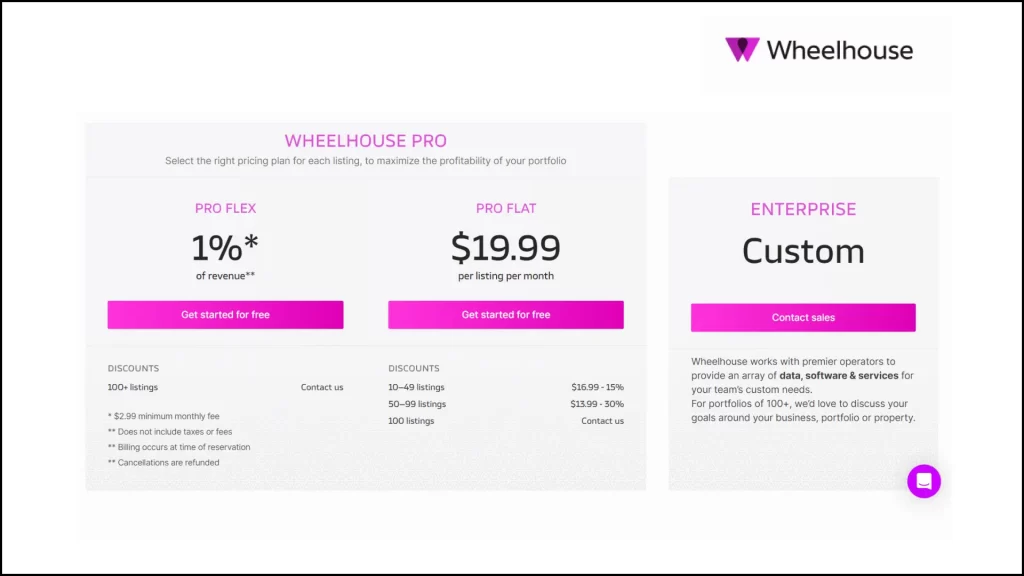
Pro Flex: This plan charges 1% of revenue with a minimum monthly fee of $2.99. Billing occurs at the time of reservation, and cancellations are refunded.

Pro Flat: For a flat rate, this plan costs $19.99 per listing per month. Discounts are available for multiple listings:

  • 10–49 listings: $16.99 (15% discount)
  • 50–99 listings: $13.99 (30% discount)
  • 100+ listings: Contact Wheelhouse for pricing.

Enterprise: This custom plan is tailored for operators with portfolios of 100+ listings. It provides an array of data, software, and services to meet specific business needs.

Additionally, Wheelhouse offers a free plan that allows users to link their accounts, explore market reports, and test out settings to determine the best pricing strategy for their needs.

For all plans, Wheelhouse includes top features such as data-driven settings, 18 months of forward-looking pricing, daily price syncing, and 24/7 support1. It’s important to note that the prices do not include taxes or fees, and specific terms may apply.


Conclusion

Wheelhouse stands out as a premier dynamic pricing tool for short-term rental hosts, offering a suite of features designed to optimize revenue. It provides a user-friendly interface and integrates seamlessly with popular platforms like Airbnb and TripAdvisor. With Wheelhouse, hosts can expect up to a 20% increase in rental income, thanks to its data-driven pricing strategies that reflect real-time market trends.

Key benefits include a variety of pricing options to match your risk appetite, cost efficiency with discounts for multiple listings, and robust market reports that guide informed decision-making. Despite some limitations, such as the lack of a mobile app and integration with certain platforms, the advantages of using Wheelhouse are clear.

Don’t miss out on the opportunity to elevate your rental business. Try Wheelhouse today and experience firsthand how dynamic pricing can transform your earnings. Sign up, link your listings, and let Wheelhouse’s advanced algorithms do the work for you. It’s time to work smarter, not harder, and let Wheelhouse guide you to greater profitability.

Unlocking Revenue with PriceLabs Pricing System

Price Labs is a dynamic pricing system designed to optimize revenue for property managers and hosts in the hospitality industry. Utilizing an advanced algorithm, PriceLabs analyzes market data, demand patterns, and seasonal trends to recommend daily rates. This system automates pricing adjustments, allowing businesses to respond to real-time supply and demand without manual intervention.

The dynamic pricing model is particularly beneficial for various types of accommodations, including Airbnb properties, hotels, and vacation rentals. It helps maximize revenue by adjusting prices based on several factors, such as time of year, day of the week, and local events or holidays. PriceLabs’ transparent approach and user-friendly interface make it a valuable tool for those looking to enhance their revenue strategy through intelligent pricing.


Understanding Pricelabs


What is Pricelabs software

The core functionality of PriceLabs revolves around its dynamic pricing and revenue management capabilities for the hospitality industry. Here are the key features:

Dynamic Pricing: PriceLabs provides automated daily rate updates based on market data, demand, and your listing’s performance. This helps in optimizing the pricing strategy for various types of accommodations.

Market Dashboard: Access to market data for vacation rentals anywhere in the world, which can be used to make informed pricing decisions.

Portfolio Analytics: A real-time reporting system that displays important vacation rental KPIs and listing-level performance data. This feature allows property managers to spot actionable trends in their bookings and make data-driven decisions.

Revenue Estimator Pro: A tool within PriceLabs that helps create revenue estimates based on market data, aiding in forecasting and planning.

Pricing Strategies: Guidance on how to use PriceLabs for various scenarios, including preventing gap creation using minimum stay settings and optimizing pricing for midterm rentals.

Integration: PriceLabs integrates with over 100 Property Management Systems (PMSs) and channel managers like Airbnb and Vrbo, providing seamless automation of pricing adjustments.

These functionalities collectively empower property owners and managers to maximize their revenue potential through strategic and data-driven pricing adjustments.


The Importance of Pricelabs Dynamic pricing

PriceLabs’ dynamic pricing is a critical component in revenue management for the hospitality industry. Its importance lies in several key areas:

Maximizing Revenue: By adjusting prices based on real-time demand and market conditions, PriceLabs helps businesses optimize their revenue potential.

Increased Competitiveness: The ability to respond quickly to market changes with dynamic pricing keeps businesses competitive.

Improved Customer Satisfaction: Tailoring prices to customer preferences and behaviors can enhance satisfaction and loyalty.

Data-Driven Decisions: Utilizing analytics and market data, PriceLabs enables informed decision-making for pricing strategies.

Efficiency and Automation: The automation of pricing adjustments saves time and reduces the need for manual intervention, making operations more efficient.

Dynamic pricing is not just about lowering prices to fill inventory; it’s about finding the optimal price point for each product at every moment, which can sometimes mean increasing prices during periods of high demand. This approach ensures that businesses are not leaving money on the table and are capitalizing on opportunities to generate more revenue¹. In essence, dynamic pricing as part of revenue management is about selling the right product to the right customer at the right time for the right price.


Key Features of Pricelabs


Market Report

PriceLabs provides market insights through its Market Dashboards, which are a key feature of the platform. These insights help property managers and hosts to optimize their pricing strategies, stay ahead of competitors, and make informed investment decisions by leveraging data-driven analytics layered on top of user-controlled inputs and settings. Here’s how they work:

Automated Dashboards: The Market Dashboards are fully automated and personalized, offering users actionable insights through easy-to-understand graphs and data visualizations.

Daily Updates: They are updated daily to reflect the latest market trends, competitor pricing, and performance metrics.

Customizable Data Views: Users can customize the data views to focus on the information that is most relevant to their needs.

Key Performance Indicators (KPIs): The dashboards detail important KPIs such as estimated revenue, average Revenue Per Available Room (RevPAR), occupancy rates, Average Daily Rate (ADR), number of active listings, and number of bookings.

Comparative Analysis: Users can compare current performance with past data to identify trends and make informed decisions.

Market Research: PriceLabs’ dashboards enable users to track short-term rental (STR) booking data for their location, helping them understand what is happening in their market.


Pricing Engine

The algorithm and mechanics behind PriceLabs’ pricing engine are designed to optimize pricing for rental properties by analyzing a multitude of factors. This multi-layered approach allows PriceLabs to provide dynamic, data-driven pricing recommendations that are tailored to the specific needs and performance of each property. Here’s a breakdown of how it works:

Base Price Setting: The algorithm starts with a base price, which is the average nightly rate around which dynamic adjustments are made. This base price is determined by the property’s attributes and current performance.

Seasonal Factors: It incorporates seasonal factors derived from historical data of rentals and hotels in the area. For the latest algorithm, Hyper Local Pulse (HLP), seasonality is calculated based on hyper-local data, while for older algorithms, it’s based on a broader region or city.

Demand Factor: The engine integrates a demand factor that accounts for day-of-week trends, events, and holidays. This helps forecast high and low demand periods, ensuring responsive pricing to market dynamics.

Pacing Factor: In some markets, a pacing factor is added when projected demand significantly diverges from historical patterns. This is calculated by assessing how far ahead or behind a market’s occupancy is compared to previous years.

Customizations and Overrides: The algorithm then adds any pricing customizations set at the listing, group, or account level, including last-minute discounts, orphan day prices, and other preferences. Date-specific overrides are also factored in.

Minimum and Maximum Price Limits: Finally, the engine enforces minimum and maximum price limits set by the user to ensure prices do not fall below or exceed specified thresholds. Users can establish different limits for specific seasons and holidays.




Integration with Rental Platforms

PriceLabs integrates with short-term rental platforms through a comprehensive system that connects with various property management systems (PMS) and channel managers. This integration capability is a key feature of PriceLabs, enabling property managers to efficiently manage pricing strategies and optimize revenue across their entire portfolio of short-term rental properties. Here’s how the integration process typically works:

Direct Integration: PriceLabs directly integrates with over 100 PMS and channel managers, including popular platforms like Airbnb and Vrbo. This allows for seamless synchronization of pricing recommendations across multiple channels.

API Connectivity: For platforms where direct integration may not be available, PriceLabs offers an open API framework. This allows PMSs to connect with PriceLabs and send price recommendations to booking channels.

User-Friendly Interface: The integration is designed to be user-friendly, allowing property managers to easily connect their PMS with PriceLabs and start using dynamic pricing without extensive technical knowledge.

Automated Updates: Once integrated, PriceLabs can automatically update prices across all connected platforms, ensuring consistent pricing and maximizing revenue potential.

Customization: Users have the option to customize the integration settings, such as setting minimum and maximum rates, minimum stay requirements, and other pricing rules, which are then applied across all platforms.


Pros and Cons of Using Wheelhouse


Pros of using Wheelhouse

PriceLabs is a dynamic pricing and revenue management software that offers several advantages for short-term rental operators and hospitality businesses. These benefits suggest that PriceLabs can be a valuable tool for those looking to optimize their pricing strategy and improve their business performance in the hospitality sector.
Here are some of the pros of using PriceLabs:

Dynamic Pricing: PriceLabs automates the process of adjusting pricing, which can increase occupancy and maximize revenue.

Ease of Use: Users have found the interface to be intuitive and easy to work with.

Customer Support: The customer support is highly rated, with quick responses to questions and the ability to connect directly with key team members.

Integration: It integrates seamlessly with various hosting software, making it easier to manage pricing across different platforms.

Market Data: Provides great market data that can help in positioning rental properties for maximum profitability.

Automation: The software fully automates the pricing process, saving time and effort for the business owners.

Revenue Increase: Some users have reported that using PriceLabs has doubled their revenue with less wear and tear on the properties.


Cons of using Wheelhouse

These cons highlight the importance of users being prepared to invest time in learning and managing the system to ensure it meets their pricing strategy needs effectively. While PriceLabs offers many benefits, there are some potential drawbacks to consider:

Additional Costs: Some users feel that having to pay an extra fee for market analysis is not ideal.

Learning Curve: The platform can be confusing and not very straightforward for new users.

Active Management: It requires regular monitoring and adjustments, as the pricing doesn’t manage itself.

Complex Customizations: The configuration for automatic updates can be difficult, with multiple levels of customization that may not be easily understandable.

Marketplace Dashboards: There is feedback suggesting that the marketplace dashboards lack development and may not provide much value.

User Interface: Although improved, some users feel that the user interface lags behind other similar tools.

Data Display: Issues have been reported with the display of sold nights not showing the correct values.


Pricing Of Price labs

Price Labs offers a variety of pricing plans tailored to the number of properties you manage. Here’s a detailed breakdown of their pricing as of 2024:

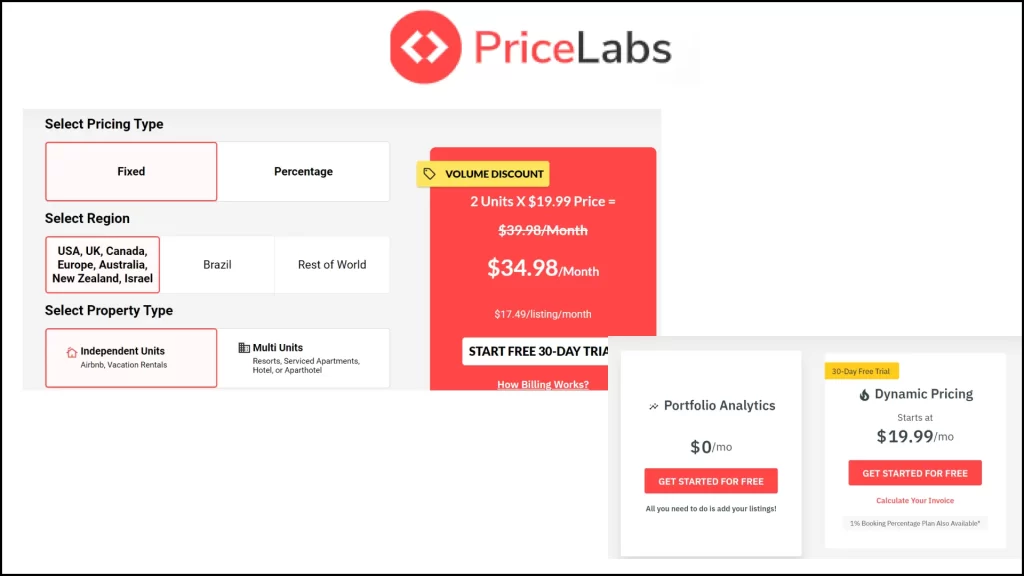
Free Trial: PriceLabs provides a 30-day free trial with no credit card required. During the trial, you have access to all the features of Dynamic Pricing.

Post-Trial Pricing: After the trial, there’s a flat monthly pricing with no commission and no long-term contracts.

Dynamic Pricing: The cost for Dynamic Pricing varies based on the number of properties:

  • 1 property: $19.90 per month
  • 2-5 properties: $14.99 for each property after the first
  • 6-15 properties: $10.99 for each property after the fifth.
  • Market Dashboard: This is a separate product from Dynamic Pricing and has its own pricing:
  • Up to 1000 listings: $9.99 per month
  • Up to 5000 listings: $19.99 per month
  • Up to 10,000 listings: $39.99 per month.

These plans are designed to cater to different sizes of property management operations, from individual hosts to large property managers. It’s important to note that the Market Dashboard, which provides market insights and analytics, is billed separately from the Dynamic Pricing tool.


Conclusion

In conclusion, PriceLabs is a sophisticated dynamic pricing and revenue management tool that can be highly beneficial for property managers and hosts in the short-term rental market. Its strengths lie in its ability to automate pricing strategies, integrate with various property management systems, and provide valuable market data insights. Users can expect an intuitive interface and responsive customer support, which enhances the overall user experience.

However, it’s important to consider the potential downsides. The learning curve for new users, the need for active management, and the additional costs for market analysis are factors that could influence the decision to use this service. The complexity of customizations and the development of marketplace dashboards also require attention to ensure they align with the user’s needs.

The pricing structure of PriceLabs is designed to accommodate a range of users, from individuals with a single property to large-scale operations with multiple listings. The clear, flat-rate monthly pricing post-trial is a plus for those wary of commission-based models, and the separate billing for the Market Dashboard allows users to choose services based on their specific requirements.

Overall, PriceLabs offers a powerful set of tools that, when used effectively, can significantly enhance revenue and operational efficiency. It’s a solution well-suited for those willing to invest the time to understand and leverage its full potential to stay competitive in the dynamic market of short-term rentals.